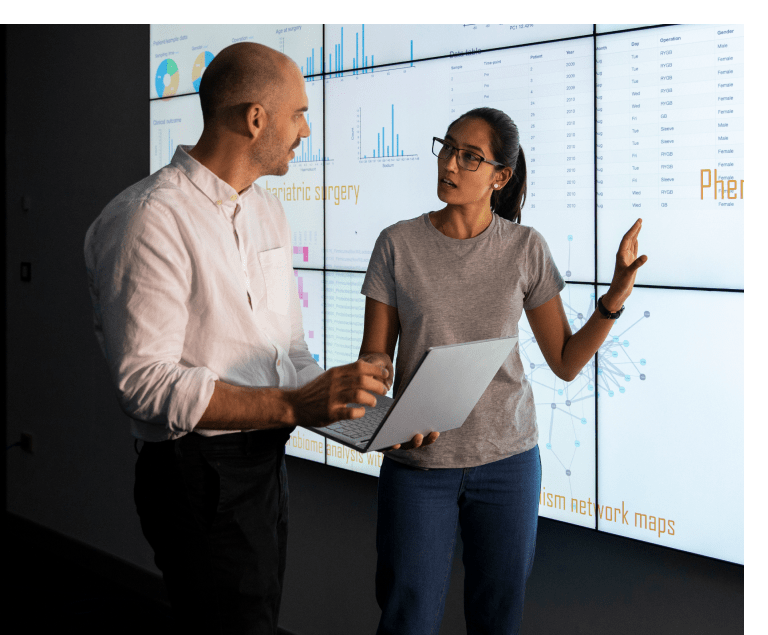




Throughout the program, you’ll develop the technical and professional competencies needed to solve real-world problems using data science, AI, effective communication and ethical decision-making.

Core SkillsWhat You’ll Learn
Data Science Foundations
Apply the data science lifecycle to solve real-world problems.
Data Analysis and Storytelling
Analyze, visualize and communicate insights from data.
AI and Machine Learning
Build and apply AI and machine learning models.
Responsible Data Science and AI Ethics
Evaluate ethical, societal and governance considerations in data science.
Collaborative Problem Solving
Work effectively on multidisciplinary data science teams.
Data-Driven Decision Making
Use analytical insights to support strategic decisions.

Apply Data Insights to Solve Today’s Greatest Challenges

At the School of Data and Information Sciences, at the University of North Carolina at Chapel Hill, we view data as the universal language of collaboration.

The online Master of Applied Data Science (MADS) program gives you a holistic understanding of the data life cycle, preparing you to effectively — and ethically — collect, process, manage and analyze data. Ultimately, you will be able to translate your insights into a clear narrative that business, government and social leaders can use to drive action.

Receive More Information
Apply Now

The Master of Data Science at a Glance

concentrations

10 Courses, 1 Optional Immersion

calendar

4 Terms to Complete Full-Time

Real World, Team-Based Capstone

waiver

GRE Scores Not Required

What Classes Do You Take in the UNC MADS Program?

The 30-credit online Master of Applied Data Science requires 10 courses: six core courses, three elective courses and a team-based capstone project.2 These courses span essential technical skills and advanced AI/ML applications.

Early coursework — including Programming Methods for Data Science and Mathematical Tools for Data Science — establishes the coding, statistical and computational foundations needed for success in advanced courses such as Machine Learning, Deep Learning and the team-based Capstone experience.

How Long Does It Take to Complete the Program?

The online Master of Applied Data Science program offers two flexible pacing options designed to support working professionals and students with different schedules and goals. Students may choose:

The Standard track, which includes two courses per term and can typically be completed in about five terms (approximately 20 months)

Download the Standard Path Course Sequencing here.

The Accelerated track, which includes three courses per term and allows students to finish in as few as four terms (approximately 15–16 months)

Download the Accelerated Path Course Sequencing here.

Students may adjust their pace based on professional and personal commitments; however, all degree requirements must be completed within five years.

What Do You Learn in the Online Master’s in Data Science Program?

The curriculum equips you to thoughtfully leverage every stage of the data life cycle — collecting, curating, interpreting, visualizing and applying — to identify and tell a story through data. Building on a foundation of data governance and ethics, as well as a continual focus on real-world applications, you will:

  • Dive into the programming and statistical foundations of data science
  • Explore the data life cycle and advanced methods to work with big data as well as relational and non-relational databases
  • Master advanced methods in machine learning, deep learning and natural language processing
  • Explore the important possibilities of data visualization and communication

Core Courses

The MADS curriculum combines required core coursework, elective options and a team-based capstone experience.

  • This course discusses foundational stages in the data science lifecycle, using a common modern toolkit, and introducing methods and implementations of relational database management systems suited for data science applications.

    Students gain fluency across the full data science workflow, while also developing data science habits (version control, documentation, critical thinking about data, among others) expected in modern data science projects.

    Section Instructors: Donna Dueker, Michael Herron, Andrea Johnston, Adam Lee, Rei Sanchez-Arias

  • This course provides students with advanced concepts on the construction and use of data structures and their associated algorithms.

    Concepts such as abstract data types, lists, stacks, queues, trees and graphs are discussed. Algorithms for sorting, searching, hashing are covered along with an introduction to numerical error control.

  • The coding-oriented course covers the concepts underpinning and the applications of statistical modeling/inference. Students build models with real-world data and modern data science toolkits in Python and R like Scikit-learn and TidyModels. Concepts covered in this course include:

    • Foundations in probability including basic rules, bayes formula, basic distributions
    • Sampling and the central limit theorem
    • Bootstrapping, confidence intervals, hypothesis testing, multiple testing
    • Linear models, basic and multiple regression, inference for regression, regularization
    • Prediction, model interpretation, model evaluation
    • Classification, logistic regression and tree-based methods

    Section Instructors: Donna Dueker, Chuck Pepe-Ranney

  • This course explores the foundational concepts of ethics in data science and Al. This overview sets the stage for a deep understanding of what ethical frameworks mean in practice, providing students the opportunity to create actionable examples.

    By focusing on a wide variety of case studies throughout a myriad of industries and settings, this class develops leaders who can effectively integrate and leverage data science solutions while ensuring responsible and transparent use of data in a variety of roles.

    Section Instructors: Grant Glass, Rei Sanchez-Arias, Kathryn Wymer

  • This course presents the mathematical intuition, theory and techniques driving the numerical computation methods used for processing and analyzing data in various real-life problems.

    Topics include dimensionality reduction, linear and non-linear approximation, frequency and wavelet analysis, and a glimpse into the mathematics of deep neural networks, classification, large-scale and high-performance numerical computing.

    Each topic will be motivated by a data analysis challenge, introducing the mathematical intuition, theory and techniques used to address it and conclude with a coding component with real data.

    Section Instructors: Tanner Slagel, Rei Sanchez-Arias

  • This course equips students with knowledge of existing tools for predictive analytics and foundational concepts in machine learning. The course covers core principles of machine learning and pattern analysis.

    Topics include maximum likelihood estimation, regression, classification; cross-validation, generalization and overfitting, introduction to neural networks, nonparametric estimators, clustering, tree-based methods, autoencoders, and kernel methods.

    Applications in tabular, image and textual data for supervised and unsupervised learning tasks are covered.

    Section Instructors: Derek Chiang, Jonathan Schlosser, Rei Sanchez-Arias

  • This course provides students with an in-depth look at deep learning fundamentals and applications with emphasis on their broad applicability to problems across a range of disciplines. Students learn to tackle practical issues that arise during the life cycle of data, both in the cloud and on the Edge.

    Topics include regularization, optimization, convolutional networks, sequence modeling, generative learning, instance-based learning and deep reinforcement learning. Students complete several substantive programming assignments using relevant modern tools and frameworks.

    Section Instructors: Sabby Gupta, Jonathan Schlosser

  • Masters of Applied Data Science (MADS) students are required to complete a capstone project. Capstone projects challenge students to acquire and analyze data to solve real-world problems using techniques they have learned in the program.

    Project teams consist of three to four students that work together with a project sponsor to create a plan and execute it, culminating in a final presentation and delivery of a demonstrable artifact such as a dashboard or codebase.

    Section Instructor: Rei Sanchez-Arias

Electives Offered

  • This course explores the intermediate-level design and implementation of database systems, with an emphasis on scalable, distributed database systems.

    Hands-on exercises in the course deepen students’ knowledge of advanced relational database management and cover current and emerging practices for handling big data and large-scale database systems.

    Concepts include design and implementation of relational databases, exploration of distributed data structures, including graph, document, and key-value storage models, and scalable and resilient query processing.

    Section Instructors: Adam Lee, Rafael Salas

  • This course equips participants with practical tools to estimate causal effects in real-world settings. After building a solid formal foundation, students will learn to design experiments, leverage natural experiments, and analyze observational data using modern causal inference methods.

    Ideal for those who want to move beyond predictive analytics in order to answer causal questions in their work.

    Section Instructor: Donna Dueker

  • This course provides students with a foundational understanding of visual perception and data visualization design practices.

    Students gain expertise in using visualization for tasks such as exploratory analysis and storytelling to support both data-driven discovery and communication.

    The class focuses on hands-on experiences with commonly used data science tools and technologies.

    Section Instructor: Vincent Stuntebeck

  • This course introduces the design and operation of machine learning systems in cloud environments. Students gain hands-on experience deploying and monitoring models at scale, building data pipelines and applying distributed computing.

    Emphasis is placed on leveraging cloud technologies for efficient data handling, AI applications, and end-to-end life cycle management of ML solutions.

    Section Instructor: Rafael Salas

  • This course prepares data scientists with a strong foundation in machine learning to master the implementation and deployment of advanced AI systems in production environments. Reflecting the rapidly evolving landscape of Al, students will gain hands-on experience with state-of-the-art LLMs, advanced RAG architectures, production-grade agent frameworks, comprehensive security testing, cost optimization strategies and industry-standard MLOps/LLMOps practices.

    The course emphasizes security as a foundational requirement, not an afterthought, and prepares students to build, deploy and maintain production AI systems that are secure, scalable, cost-effective and ethically sound.

    Section Instructor: Grant Glass

  • This course covers statistical and machine learning methods for the analysis of biological and health-related data. Students will examine the structure, provenance and challenges of diverse biomedical data types, including genomic and epigenomic data, population and public health data, electronic health records and biomedical imaging.

    Emphasis is placed on selecting, applying and interpreting statistical methods for hypothesis testing, association analysis and predictive modeling in biologically meaningful contexts.

    Students will critically assess sources of bias, uncertainty and methodological limitations in biomedical data science and develop skills for communicating results and caveats effectively to both computational and experimental scientists.

    Section Instructor: Chuck Pepe-Ranney

  • This course introduces methods for analyzing data that vary across space and time. Students learn to interpret spatial data, time series data and integrated spatiotemporal data, with attention to spatial heterogeneity, trends and seasonality.

    Using modern data science tools, students apply statistical techniques to real-world spatial, temporal and spatiotemporal datasets. The course culminates in demonstrating professional-level analysis and communication of spatiotemporal results.

Meet Our Interdisciplinary Faculty

The School of Data and Information Sciences serves as an interdisciplinary hub that brings together many academic units across UNC-Chapel Hill. This culture of collaboration gives you a holistic perspective on the practical and ethical ramifications of data science work.

Drawing on Carolina’s deep well of interdisciplinary research and faculty expertise, the program was initially conceptualized and developed in collaboration with key academic units across campus, including:

  • School of Data and Information Sciences
  • Department of Biostatistics at the Gillings School of Global Public Health
  • Department of Computer Science, Department of Mathematics and Department of Statistics and Operations Research at the College of Arts and Sciences

Courses in the online master’s in data science program are taught by UNC faculty and experienced data science practitioners with expertise across disciplines including computer science, statistics and operations research, mathematics, biostatistics, information and library science, health sciences, bench sciences, omics, political science, public health and environmental science.

This combination of academic expertise and current professional experience brings students perspectives informed by both research and the evolving demands of the data science field.

Professor Rei Sanchez-Arias headshot

Rei Sanchez-Arias

Teaching Associate Professor and MADS Faculty Director

reisanar@unc.edu | Rei Sanchez-Arias’s Website

Research Areas:
Data mining, machine learning algorithm development, numerical optimization, data science education

Courses Taught in the MADS Program:

  • Foundations of Applied Data Science
  • Governance, Bias, and Ethics in Data Science and AI
  • Machine Learning
  • Mathematical Tools for Data Science
  • Capstone

Rei Sanchez-Arias joins the School of Data Science and Information Sciences (SDSS) at UNC-Chapel Hill as a teaching faculty and faculty director for the Master of Applied Data Science (MADS) program. Before joining the school, he was most recently an associate professor of data science and assistant chair in the department of data science and business analytics at Florida Polytechnic University. He strives to implement innovative and effective methods for teaching and learning of data science, has been recognized with excellence in teaching awards and has been an invited speaker at multiple conferences to discuss topics in data science education.

Sanchez-Arias earned a BSc in Mathematics from Universidad del Valle (Colombia) and a PhD in Computational Science from the University of Texas at El Paso. He completed a postdoctoral researcher appointment for the Army High Performance Computing Research Center working in reduced order models and data compression techniques. In recent research projects, he has focused on the application and development of data mining and statistical learning methods and algorithms to propose solutions to applied sciences and engineering problems. Sanchez-Arias is a member of the Society of Industrial and Applied Mathematics (SIAM) and INFORMS, where he serves on the education outreach committee.


Professor Chuck Pepe-Ranney headshot

Chuck Pepe-Ranney

Lead Faculty and Section Instructor, Master of Applied Data Science

chuckpr@email.unc.edu

Courses Taught in the MADS Program:

  • Statistical Modeling and Inference for Data Science
  • Data Science Methods for Biological Sciences and Health Informatics

Chuck Pepe-Ranney teaches Statistical Modeling and Inference for Data Science and Data Science Methods in Biological & Health Sciences in the Master of Applied Data Science program and teaches Data Science Basics at the Gillings School of Global Public Health. He has over a decade of experience as a genomics data scientist in biotech, spanning individual contributor and leadership roles. He completed his PhD at the Colorado School of Mines studying hot-spring microbiology and later studied microbial carbon cycling in soil as a postdoctoral researcher at Cornell University.

He has worked extensively with genomics data and has contributed to studies of a variety of ecosystems, from the human microbiome and agricultural soil to sea-star viruses. In biotech, he has also applied machine learning and AI to help design and improve protein-based drugs. While in graduate school, he taught computational microbiome analysis as a teaching fellow in the Microbial Diversity Course at Woods Hole, and he has designed biotech data platforms to manage next-generation sequencing, microbial genome and metagenomics assets.

Professor Derek Chiang headshot

Derek Chiang

Vice President and Head, Computational Biology, Bayer Pharmaceuticals

Section Instructor, Master of Applied Data Science

dchiang@unc.edu

Derek Chiang is a Section Instructor in UNC-Chapel Hill’s Master of Applied Data Science program and Vice President of Computational Biology Oncology at Bayer Pharmaceuticals. He brings extensive experience applying computational biology, genomic technologies and statistical learning to pharmaceutical research and precision medicine, with previous leadership roles at Merck and Novartis. Chiang holds a Ph.D. in Molecular and Cell Biology from the University of California, Berkeley and a B.S. from the University of North Carolina at Chapel Hill.

How You Get Career-Ready

UNC-Chapel Hill has deep ties with regional, national and global partners in industry, government and the nonprofit sector. This in turn gives us direct insight into the needs of employers. The data science master’s program incorporates these insights to position you for success in the data science workforce. Learn more about what data science is.

Learn Modern Skills and Tools

The curriculum teaches the latest data science trends, skills and tools being used today, such as advanced programming methods, big data and NoSQL databases, machine learning applications, AI ethics and more.

Gain Practical Experience

In the capstone, you’ll work with industry, government and community partners and mentors to solve real-world data challenges. Faculty and staff will leverage their networks to identify projects and organizations.

Practice Working in Teams

Data scientists must be able to clearly communicate with stakeholders, and solve problems as part of an interdisciplinary team. Group assignments and a team-based capstone arm you for collaborative work.

Learn How to Advance Your Data Science Career

Solving the grand challenges of our time requires the accurate and ethical application of data. Request information to learn more about Carolina’s approach to applied data science.

Receive More Information

Diverse Career Paths in Data Science

A Master of Applied Data Science degree can help prepare professionals for technical, analytical and leadership-oriented roles across industries including technology, health care, finance, government, consulting and research.

Graduates may pursue career paths such as machine learning engineer, data architect, data engineer, business analyst, enterprise architect, applications architect or machine learning scientist. Many professionals also apply advanced data science skills within their current field to support data-driven decision-making, improve operational efficiency and address complex organizational challenges.

Take the Next Step in Your Data Science Career

The online Master of Applied Data Science is designed for analytically minded professionals who want to have a greater influence at work — and help solve today’s grand challenges in North Carolina and beyond. Request information to learn more about the program today.

Data Science Careers Are on the Rise

By acquiring the skills and experience to become a data scientist, you’ll position yourself to meet employers’ increasing demand for data-driven discovery and decision making — and advance in a fulfilling career where you can have a practical, measurable impact.

35%

projected employment growth for data scientists from 2025–2035

$120,230

estimated median salary for data scientists and advanced analytics professionals

Career and Salary

The online Master of Applied Data Science prepares graduates for technical and strategic roles spanning enterprise technology, health care, finance, government, research and cloud computing.

Job Title2025 Median Annual WageTarget Sector / Work Setting
Data Scientist
$120,2303
Enterprise Tech, Finance, Healthcare
Software Developers
$134,0404
AI Labs, Automation, Cloud Infrastructure
Data Architect / Administrators
$126,7605
E-commerce, Government, Big Data Warehousing
Operations Research Analyst
$88,9406
Business Intelligence, Marketing, Public Policy
Receive More Information

Gain inspiration from students who are turning curiosity into innovation with our online master’s in data science program

Winnie Ekwegh speaking into a mic on the stadium at gradutation

“UNC MADS helped me turn a passion for solving real-world problems into the confidence and skills to pursue them. Learning from expert faculty alongside a supportive community showed me there’s almost no limit to what I can achieve with data science.”

— Winnie Ekwegh

Gerhard Ungerer headshot

“It has been MANY years since I completed my undergraduate degree, so I was initially concerned whether I would be successful in a graduate program. I completed the preparatory classes and then followed the MADS curriculum as designed. It was a good experience and prepared me for pursuing the Ph.D in Data Science should I choose to do so.”

— Gerhard Ungerer

Christopher Dennis graduation headshot

“UNC MADS strengthened my technical expertise while changing the way I approach complex healthcare challenges. Beyond the skills I gained, the experience gave me the confidence to keep learning, lead data-driven innovation, and make a meaningful impact throughout my career.”

— Christopher Dennis

What Are the Admissions Requirements for the UNC Online Master of Applied Data Science?

UNC-Chapel Hill seeks motivated analytical thinkers who are passionate about using data to solve problems and improve people’s lives. The online Master of Applied Data Science is a practice-based program and is geared more toward practitioners than researchers.7

Admissions Highlights:

  • Two start dates per year: January and August
  • Bachelor’s degree required
  • Skills refresher courses available
  • Students enroll in either two courses per term (Standard track) or three courses per term (Accelerated track)

No GMAT/GRE scores are required.

Review upcoming deadlines and a complete list of application requirements for the online master’s of data science.

Prerequisite Checklist

To be eligible for admission, you must hold a bachelor’s degree from a regionally accredited institution. A specific technical degree is not required, but applicants should demonstrate competency in programming, statistics and probability, and linear algebra.

To support students from a wide range of academic and professional backgrounds, applicants can access a selection of self-paced refresher courses — most offered through edX, the program partner of the UNC School of Data and Information Sciences to help strengthen prerequisite competencies before the program begins. Courses are free to audit, with optional verified tracks available for students who would like graded feedback and a certificate of completion.

Upcoming Cohort Deadlines

The online Master of Applied Data Science program offers two start dates each year: January and August.

CohortEarly Priority DeadlinePriority DeadlineFinal Deadline
January 2027 Cohort
September 22, 2026
October 20, 2026
November 10, 2026

*Application deadlines are subject to change. Prospective students should confirm all dates through the UNC-Chapel Hill admissions office prior to submitting an application.

Tuition and Financial Aid for the Online Data Science Master’s Program

The online Master of Applied Data Science program requires 30 credits. Tuition varies by residency and is subject to change each academic year. For the most current tuition and fee information, visit UNC-Chapel Hill’s official Tuition and Financial Aid page.8

Tuition

Tuition varies by residency and is subject to change. For the most current tuition and fee information for UNC-Chapel Hill’s online Master of Applied Data Science program, visit UNC-Chapel Hill’s official tuition and financial aid page.

Tuition DetailsNorth Carolina ResidenceOut-of-state Residence
Program credits
30
30
Tuition per credit
$1,211.78
$1,760.06
Online student fee
$28.71
$28.71

Explore Financial Aid Options

Explore Financial Aid Options

Eligible graduate students can explore federal financial aid by completing the FAFSA. UNC-Chapel Hill’s school code is 002974. You do not need to wait until you’re admitted to begin the financial aid process. Complete the FAFSA form to get started.

In-State vs. Out-of-State Tuition

North Carolina residents and nonresidents pay the same tuition rate for the online Master of Applied Data Science. For 2026–27, tuition is $1,211.78 per credit for North Carolina residents and $1,760.06 per credit for nonresidents.

Accreditation

The University of North Carolina at Chapel Hill is accredited by the Southern Association of Colleges and Schools Commission on Colleges (SACSCOC) to award baccalaureate, master’s and doctoral degrees.

Accreditation by SACSCOC signifies that the university meets established standards for academic quality, institutional effectiveness and student support.9

Carolina’s Approach to Online Learning

UNC-Chapel Hill’s faculty and partnerships with technology experts have positioned us to design a research-based online learning experience that fosters collaboration, cultivates meaningful connections, and prioritizes student needs.

  • Interact with diverse peers and faculty in live online classes, held on Zoom at convenient times for working professionals.
  • Learn from Carolina faculty with years of in-person and online teaching experience.
  • Access a sophisticated digital campus, where you can adjust settings, view grades, and complete multimedia assignments.
  • Find comprehensive support services, including academic advisors, faculty mentors, tech support, career guidance and more.

Connect With Your Peers Through an Optional In-Person Immersion

Take advantage of an optional, non-credit immersion on campus in Chapel Hill, North Carolina. The experience gives you an opportunity to gain new perspectives and strengthen relationships with classmates and professors, though all required coursework can be completed entirely online.

FAQs About UNC’s Online Master of Applied Data Science (MADS)

  • Data science is a broad field focused on using tools like artificial intelligence, machine learning, statistics and programming to uncover patterns, make predictions and solve complex problems using large amounts of data.

    Data analytics is a more focused area within data science that centers on examining historical data to identify trends, create reports and visualizations, and support day-to-day business decision-making. While data analysts typically interpret existing data, data scientists are often tasked with building predictive models and developing new data-driven solutions.

  • At UNC-Chapel Hill, the online Master of Applied Data Science (MADS) is designed for professionals who want to use data science skills to solve real-world problems across industries like health care, business, technology, government and public policy.

    While a traditional MS in Data Science often places a heavier emphasis on theory, advanced mathematics, and research preparation, the MADS program focuses on practical application, collaborative problem-solving, and hands-on experience with modern data science tools and workflows. This practice-based approach helps students prepare for immediate impact in industry and professional settings.

  • To apply to the online Master of Applied Data Science (MADS) program at UNC-Chapel Hill, you must hold a bachelor’s degree from an accredited institution.

    While applicants come from a variety of academic and professional backgrounds, the admissions team recommends having foundational knowledge in programming, statistics and linear algebra. GRE scores are not required for admission. Applicants should be prepared to submit transcripts, a résumé or CV and a statement of purpose as part of the application process.

  • Students should have a computer and reliable internet connection to participate successfully in the online Master of Applied Data Science program. Recommended equipment includes:

    • Computer: Latest versions of at least two browsers, with at least 4 GB of RAM (8 GB ideal) and a 2 GHz dual-core or faster processor
    • Operating system: Mac OS X 10.9 or higher or Windows 7 or higher
    • Internet: A hardwired Ethernet connection is preferred, or a stable Wi-Fi connection with download speeds of at least 10 MB/s and upload speeds of at least 5 MB/s
    • Headset or headphones: With speakers and microphone
    • Webcam: Internal or external
    • Dual monitor: Recommended
  • No, you do not have to bring your own project for the capstone course.

    Students are matched with a project where they analyze data to solve a real-world problem using skills developed throughout the program. Capstone project teams consist of three to four students and a project sponsor. Sponsors include partner organizations from government, industry and nonprofit sectors.

  • Data science does involve math, but you do not need to be a mathematician to succeed in the field. Concepts such as statistics, probability, linear algebra and calculus help data scientists understand patterns in data, build predictive models and make informed decisions.

    While many modern tools and programming languages automate calculations, having a solid understanding of the underlying concepts is important for interpreting results, evaluating models and solving complex problems with confidence.

  • Coding is an important part of data science because it helps professionals collect, organize, analyze and visualize large amounts of data. Many data scientists use programming languages like Python or R to build models, automate workflows and solve complex problems.

    That said, not every role requires advanced coding expertise from day one. Some entry-level and mid-level positions focus more on working with existing tools, dashboards, and datasets while you continue building your technical skills over time.

  • For many professionals, earning a master’s degree in data science can open the door to new career opportunities, leadership roles, and higher earning potential in a rapidly growing field. As organizations continue investing in artificial intelligence, analytics, and automation, professionals with advanced data skills are increasingly in demand across industries.

    A graduate program can also help you build practical technical expertise in areas like machine learning, data visualization, and predictive analytics while expanding your professional network and real-world problem-solving experience. For students looking to transition into tech, advance in their current field, or move into data-driven leadership roles, a master’s degree can provide a strong foundation for long-term career growth.

  • A Master of Applied Data Science degree can prepare you for a wide range of technical, analytical and leadership roles across industries such as technology, health care, finance, government, consulting and research.

    Graduates may pursue careers such as machine learning engineer, data architect, data engineer, business analyst, enterprise architect, applications architect or machine learning scientist.

    Many professionals also apply data science skills within their current industry to lead data-driven decision-making, improve operations and solve complex organizational challenges.

  • Salaries for data scientists can vary based on factors such as experience level, industry, location and technical specialization. According to the U.S. Bureau of Labor Statistics, the median annual salary for data scientists was $120,230 as of August 2026.

    Earning potential may also differ by industry. For example, data scientists working in computer systems design and related services earned a median salary of approximately $132,380 while professionals working in insurance carriers earned a median salary of about $108,650. As demand for artificial intelligence, machine learning, and advanced analytics continues to grow, data science professionals remain among the highest-paid roles in the technology workforce.

  • Students in the Master of Applied Data Science program come from a wide range of academic and professional backgrounds because data-driven decision-making now plays an important role in nearly every industry.

    Common industries and career sectors include:

    • Technology and Cybersecurity: Optimizing systems, improving automation and identifying security threats
    • Health Care and Public Health: Improving patient outcomes and analyzing population health data
    • Finance and Insurance: Detecting fraud, managing risk and evaluating market trends
    • Government and Education: Supporting public policy decisions and analyzing institutional data
    • Retail, Marketing and Entertainment: Personalizing customer experiences and measuring consumer behavior
    • Energy and Sports Analytics: Using predictive analytics to improve performance and operational efficiency

    Some students enter the program to transition into data-focused careers, while others want to strengthen their technical and analytical skills within their current field. The MADS curriculum emphasizes practical applications that can be applied across industries and professional settings.

  • Tuition for the online Master of Applied Data Science is charged per credit and varies by residency. For 2026–27, the rate is $1,211.78 per credit for North Carolina residents and $1,760.06 per credit for nonresidents. For additional information about tuition and financial aid, visit UNC-Chapel Hill’s Tuition and Financial Aid page.

  • The online Master of Applied Data Science (MADS) program offers two enrollment periods each year, with cohorts beginning in the Spring (January) and Fall (August) terms.

    For the most up-to-date information on application deadlines, enrollment timelines and admissions requirements, prospective students should visit the program’s admissions page.

    Students can also refer to the UNC-Chapel Hill Registrar’s academic calendar for important university dates, including term schedules, registration periods, holidays and academic deadlines.

Take the Next Step in Your Data Science Career

The online Master of Applied Data Science is designed for analytically minded professionals who want to have a greater influence at work — and help solve today’s grand challenges in North Carolina and beyond. Request information to learn more about the program today.

Receive More Information

Data compiled and verified May 2026. Cohort schedules, application dates, curriculum offerings and program information are updated periodically for the 2026–2027 academic year.

University of North Carolina at Chapel Hill partners with 2U to support the delivery of this online program. University of North Carolina at Chapel Hill has full control over the program, including all core academic functions. Click here to learn more about 2U’s roles and responsibilities.

  1. Best Online Master’s in Data Science Programs for 2024. (2024). Fortune. Retrieved August 2026. ↩︎
  2. Graduate Catalog. (2025). University of North Carolina at Chapel Hill. Retrieved August 2026. ↩︎
  3. Data Scientists. (2026). U.S. Bureau of Labor Statistics. Retrieved August 2026. ↩︎
  4. Software Developers. (2026). U.S. Bureau of Labor Statistics. Retrieved August 2026. ↩︎
  5. Database Administrators and Architects. (2026). U.S. Bureau of Labor Statistics. Retrieved August 2026. ↩︎
  6. Operations Research Analysts. (2026). U.S. Bureau of Labor Statistics. Retrieved August 2026. ↩︎
  7. Master of Applied Data Science — Admissions Requirements. University of North Carolina at Chapel Hill. Retrieved August 2026. ↩︎
  8. Tuition and Financial Aid — Master of Applied Data Science. University of North Carolina at Chapel Hill. Retrieved August 2026. ↩︎
  9. University of North Carolina at Chapel Hill 2026-2027 Catalog. University of North Carolina at Chapel Hill. Retrieved August 2026. ↩︎